About Sayra Besner, LCSW, Divorce Therapist in Miami & Across Florida
You want to know whether I actually understand this, or whether I only studied it.

Licensed therapist, divorced mom of twoIf you'd rather skip to how I actually work, that's further down. ↓
Fair question. Most of what follows is my own divorce. I'm telling you because it's the reason I work the way I do, not because you came here for my life story.
Here is the version of my life that looked correct on paper. Grad school. Married in my twenties, to a smart, driven man everyone approved of. Two kids. A beautiful house. A husband doing extremely well at work and almost never in it.
Here is what was actually happening. I had stopped working after my first child, which I still consider the single biggest mistake of my adult life. I had a toddler with a better social calendar than mine. Postpartum hit like a truck with no brakes after the second one. I was the fun, capable mom who had it all together, and I hated nearly every minute of it.
We moved to Florida as a last effort to save the marriage. Two weeks later the world shut down. I was dragging a six-year-old and a toddler through virtual school, and I remember standing in a Costco I despised thinking, very clearly: no amount of Botox or a Zara haul is fixing this.
So I blew it up.
I got divorced. I left a gorgeous house with my clothes in garbage bags and no plan. No money of my own. No job in my field for five years. People told me I was throwing my life away, and some of them were people who were supposed to be on my side.
I was a licensed therapist the entire time. I had the training, the credentials, and the clinical vocabulary for all of it. And I still had no idea what to do on a Tuesday.
That gap is the reason this practice exists.
Your version probably looks nothing like mine. Maybe you were the one who got left. Maybe there was no house, no kids, no dramatic exit, just a slow drift that ended in paperwork. Maybe you're a man reading this and none of the postpartum part applies to you at all. The details don't transfer. What transfers is the part where the life you organized yourself around stops existing, and nobody tells you what to do on Monday.
How I workHow change actually happens in my work
Insight is not the hard part. Most people who find me already understand their situation quite well. They can explain exactly what went wrong, in order, with dates. Understanding it has not helped.
What helps is sequence. There is an order to rebuilding after a divorce, and most people run it backwards. They start with dating, or a move, or a job change, before they have any current information about who they are, and then they are confused when the new thing feels like the old thing.
So we work in order. Where you actually are, not where you think you should be. Then what you inherited, meaning the patterns you learned before you had a vote in the matter. Then what you choose, which is the first time in a while anyone will ask you that. Then boundaries, which are not scripts but things that have to survive an actual phone call on an actual bad night. Then, last, what comes next.
The order is most of why it works. It is also why this is not a six-session fix, and I will not pretend otherwise.
What I built out of itI didn't have a roadmap. So I wrote the one I needed.
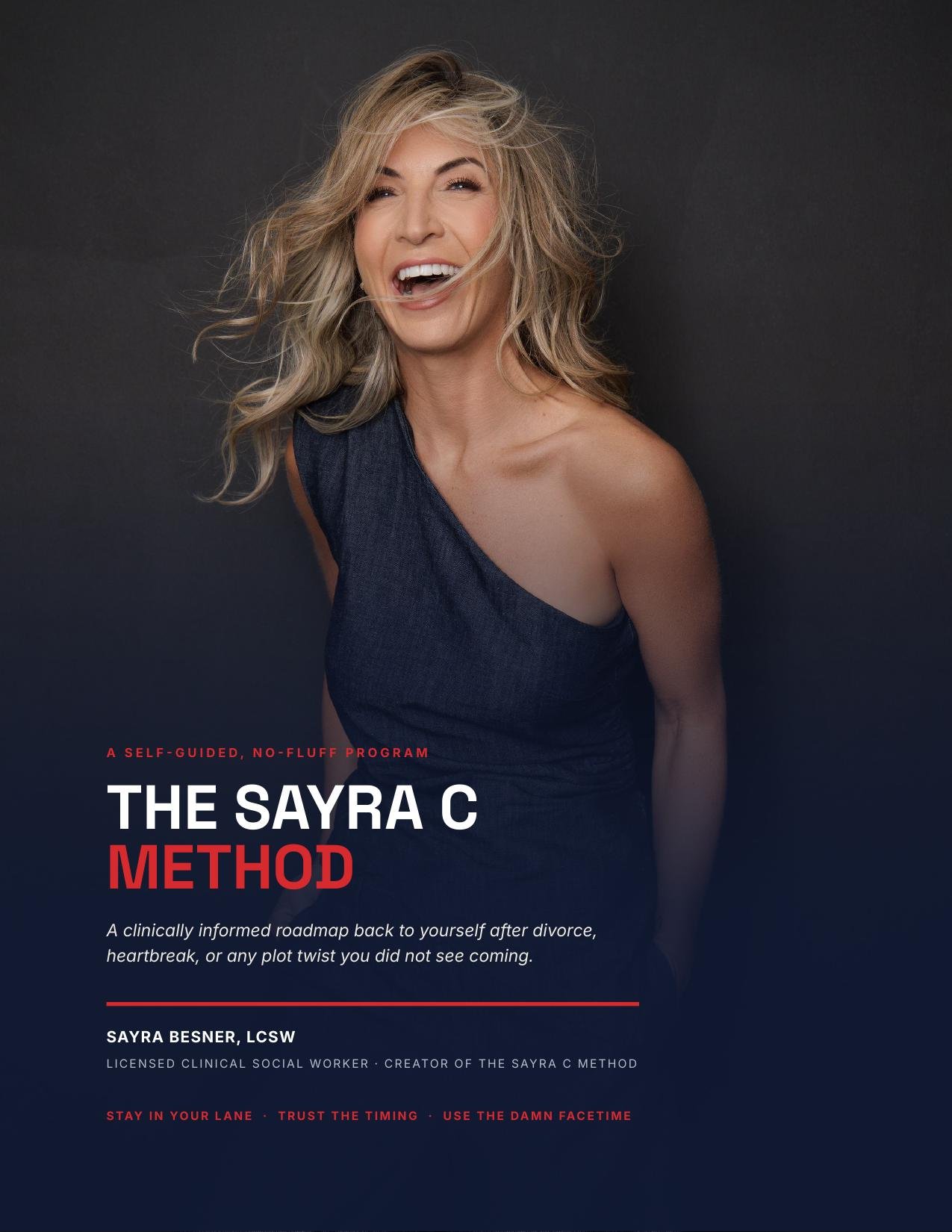
The Sayra C Method is the sequence above, written down. Forty-seven pages, five modules, eight weeks, and thirty days of affirmations for the 2 a.m. spirals.
It's the work I do in session, in a form you can start tonight without talking to anyone.
Instant download. A self-guided program, written for women rebuilding after divorce. Not therapy, and not a substitute for it.
If you've tried other thingsHow this is different from what you've already tried
If therapy felt pleasant
but unproductive
I'm direct. I don't sit in long silences waiting for you to fill them. If I think you're avoiding something, I'll say so, and then we'll talk about why. Some people find that a relief. Some find it too much. The consult exists so you can find out which one you are before you've paid me anything.
If you've read
the books
The books are fine. They give you information, and information was never the problem. What they can't do is notice the thing you keep skipping past, or tell you when you're rationalizing, or hold you to something you said you'd do two weeks ago.
If you've been told
to give it time
Time works on grief. It does very little for patterns. If you're still having the same argument with a new person, that's a pattern, and patterns don't dissolve on a schedule.
In the roomWhat I'm actually like

I swear sometimes. I use humor, because the alternative in this work is unbearable and because you're already sad enough. I will not tell you everything happens for a reason.
I take the work seriously and myself considerably less so. You are a smart adult in a bad chapter, not a patient, and I'm going to talk to you like one.
I'm also not right for everyone, and I'd rather say that here than discover it in session four.
Who I work withWomen rebuilding after divorce, which is where most of my work lives. Men, more than people expect, usually arriving later and usually opening with some version of "I'm fine." Teenagers 14 and up whose parents are splitting, and their parents, on what to say and how to co-parent from two houses.
Underneath all of it, the same problem: you built a life around a role, the role ended, and nobody handed you instructions for the part that comes after.
The credentials, since you're probably wonderingLicensed Clinical Social Worker in Florida, license #23215. MSW from Barry University. In the mental health field since 2007, starting in New York City community mental health, where I ran a program with state audits, board meetings, and relationship management across every setting you can think of, jails included. I was young, the door opened, and I swam.
Creator of the Sayra C Method, the self-guided program I built out of everything above.
I practice virtually across Florida, with an office opening in Boca Raton.
License FL #23215
Credenital LCSW
Degree MSW, Barry University
In the field since 2007
Practicing Virtually, statewide FL
STRAIGHT ANSWERSQuestions people ask before working through their divorce with me
-
No. Most people start somewhere in the middle and we sort it out from there. You don't need a timeline, a diagnosis, or a clean explanation of what went wrong. If you can tell me what this week has been like, that's plenty to start with.
-
Neither. I'm not there to grade the decision, and I've noticed that people arrive already carrying enough opinions from family, friends, and the internet. What I care about is what you do with where you are now.
-
No, though that's what I'm best known for. I have a substantial number of male clients, and the work with men is often the same work, just arriving later and with less support around it. I also work with teens 14 and up, and with parents on co-parenting.
-
Because it removes the two biggest reasons people don't start, which are time and logistics. You don't need to find parking, arrange childcare, or explain where you're going. A Boca Raton office is opening, and virtual will still be how most of the work happens.
-
Then say that on the consult. Fifteen minutes, no cost, and I'll tell you honestly what I think, including if I think you'd be better served by someone else or by something other than therapy. I'd rather refer you well than keep you.
before you decideThe worst outcome of a fifteen-minute call is that you learn I'm not your person.
Tell me what's going on. I'll tell you what I think, whether we'd work well together, and what I'd suggest either way. Nobody is signing anything.
Not ready to talk to anyone yet? Start with the Sayra C Method, $107 →