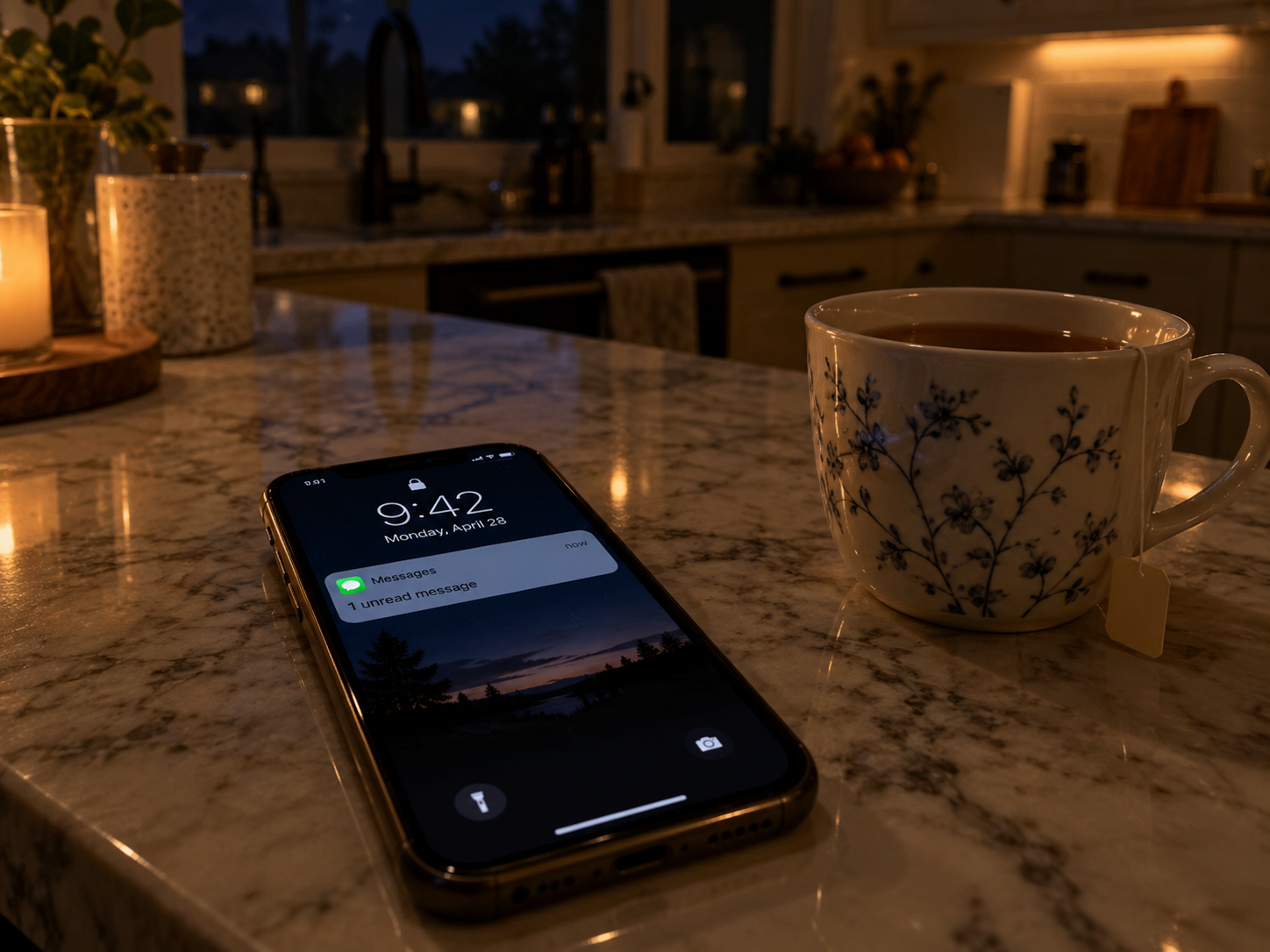
Phone lighting up on a kitchen counter at night with a message from a high-conflict co-parent.
By Sayra Besner, LCSW ·
If you're co-parenting with a high-conflict ex, you know this moment. You saw his name on the lock screen and your stomach dropped before you even opened it. It's 9:47pm. The kids are asleep. You were finally, finally sitting down.
Three paragraphs about how you "always" do this. A screenshot of the parenting plan with a sentence highlighted. A dig about your new haircut that has nothing to do with anything. And somewhere in the middle, a question about whether soccer pickup is at 5 or 5:30.
You've drafted a reply four times. One is sarcastic. One is a novel. One is just "5:30" and feels like losing. You're going to lie awake until 1am composing the perfect response in your head, and he's going to sleep like a baby.
This isn't hard because you don't know what to say. It's hard because every message is a hook, and some part of you still thinks that if you explain yourself clearly enough, he'll finally get it.
He won't. That's the part nobody says out loud. And the sooner you stop waiting for it, the sooner you get your evenings back.
Here's What's Actually Happening
High-conflict co-parenting runs on a loop. He provokes. You defend. He escalates. You over-explain. Everyone's exhausted and nothing about soccer pickup got resolved.
The loop keeps running because both of you are still, in a way, in the marriage. The arguments aren't about the calendar. They're about who was right, who gave up more, who's the better parent. The calendar is just the stage.
Here's why it matters so much to get out of it: research has been remarkably consistent for decades that what harms kids after divorce isn't the divorce. It's being exposed to ongoing conflict between their parents, especially conflict they feel stuck in the middle of (Grych & Fincham, 1990; Kelly & Emery, 2003). Your kids don't need you to win. They need the war to get quieter.
That's also why the standard advice to co-parent "as a team" can backfire. Co-parenting assumes two cooperative adults. If you only have one, you need a different model.
What It Actually Looks Like
The handoff ambush. Every exchange in the school pickup line or the Publix parking lot becomes a chance for him to bring up something new. The kids are standing right there, backpacks on, watching their parents' jaws tighten.
The text thread war. It started as logistics. Now it's 140 messages long, and you can scroll up to any point and find something that'll ruin your afternoon all over again. You've become a historian of your own misery.
The kid as messenger. "Dad says you have to bring my cleats." "Mom said you were late again." Your kids are carrying messages between houses like tiny diplomats, and they're picking up the tension along with the notes.
The calendar chess game. Swaps that get denied on principle. Last-minute changes that wreck your plans. Holidays that turn into negotiations months in advance. Every scheduling question becomes a referendum on who has control.
Why the Usual Advice for Co-Parenting With a High-Conflict Ex Doesn't Work
"Be the bigger person." You've been the bigger person so long you're practically a skyscraper. The problem is that "bigger person" usually means absorbing, accommodating, and swallowing it. That's not a strategy. It's slow erosion, and your kids can tell when you're running on fumes.
"You just need to communicate better." You communicate fine. Communication works when both people want to solve the problem. With a high-conflict ex, more communication often just means more surface area for conflict. The goal isn't better communication. It's less of it, and more structured.
"Co-parent as a team for the kids." Beautiful goal. Works great for two parents who can sit in the same room. If you can't, the better model is often parallel parenting: each parent runs their own household with minimal overlap, communication is limited to essentials, and the plan itself does most of the talking.
What the Work Actually Is
Here's the shift: you can't control him. You can control how much access he gets to your nervous system.
It starts with where you actually are. If one text can take out your whole day, that's real information. It means the hook is still landing, and we need to understand why before any script will work.
Then what you inherited. Did you grow up keeping the peace? Smoothing things over? Making sure everyone was okay? A lot of women in high-conflict co-parenting were trained early to manage someone else's mood, and that training is exactly what he's pulling on.
Then what you choose. Many people find structure helps. One example is a method called BIFF, developed by the High Conflict Institute: responses that are Brief, Informative, Friendly, and Firm. "Pickup is at 5:30. See you then." No defense. No history. No commentary on the haircut.
Then boundaries. Not as a speech you give him, but as rules you keep for yourself. Logistics only, and only on the co-parenting app. You respond during set hours, not at 9:47pm. The kids never carry messages. Boundaries have to survive an actual bad night, not just sound good in a therapist's office.
Then what's next. The goal is boring. When the exchanges get boring, it means they stopped costing you whole days.
A Few Florida-Specific Things Worth Knowing
I'm a therapist, not a lawyer, so please run these by your attorney. But a few things are useful context.
In Florida, every divorce with minor children requires a parenting plan, and the statute requires that plan to address how parents will communicate with the child, including the methods and technologies they'll use (Florida Statute 61.13). That's why your plan is your most powerful tool. The more specific it is, the less there is to fight about.
It's common for Florida family courts to order high-conflict parents onto a co-parenting app, and many attorneys recommend using one even without an order. It creates a record, keeps logistics in one place, and tends to make people more civil when they know a judge might read it.
If your plan is so vague that every week becomes a new argument, that's worth raising with your attorney. A clearer plan isn't you being controlling. It's you being done negotiating the same thing forty times.
For the South Florida Mom Who Runs Into Him Everywhere
South Florida feels huge until you're divorcing someone in it. Then suddenly it's a small town. Same school pickup line. Same mutual friends' birthday parties. Same Saturday soccer field where you can feel everyone watching the two of you not look at each other.
You don't have to perform friendliness for the sake of the audience. You also don't have to engage. A nod, a "hi," and a firm attention on your kid is enough. Your job isn't to manage how it looks. Your job is to manage what it costs you.
What This Means for You
You're not crazy, you're not too sensitive, and you're not the problem just because you're the one who's still reacting.
You can't make him reasonable. But you can make him a lot less important to how your day goes, and that's the version of this where your kids actually win.
Where to Start
Start with a free 15-minute consult. This is one of the most practical areas of my work: actual scripts, actual boundaries, and a plan for the next bad text before it arrives. Therapy for life during and after divorce is built for this.
If you want to start on your own first, the Sayra C Method walks through the boundaries piece step by step. For the legal side of your plan, see Florida's Parenting Plan, Explained for Parents.
Book your free consult and let's make the next text boring.
FAQ
What is parallel parenting? Parallel parenting is a co-parenting approach for high-conflict situations where each parent runs their own household independently with minimal direct contact. Communication is limited, usually written, and focused only on essential logistics. It reduces the opportunities for conflict so children aren't caught in the middle, and it can shift toward more cooperative co-parenting over time if things calm down.
How do I respond to a high-conflict ex's texts? Answer only the actual question, briefly and neutrally, and ignore the bait. Skip defending yourself, correcting their version of history, or matching their tone. Many people use the BIFF approach: brief, informative, friendly, firm. Waiting a set amount of time before responding can also keep you from replying from a reactive place.
Can a Florida court order us to use a co-parenting app? Florida parenting plans must address how parents communicate, and judges have broad discretion to order specific tools, including co-parenting apps, especially in high-conflict cases. Whether it makes sense for your situation is a question for your family law attorney. Many families also choose one voluntarily for the record-keeping and structure it provides.
Should I keep records of my co-parent's messages? It's generally wise to keep communication in writing and in one place, like a co-parenting app, so there's a clear record. Your attorney can tell you what's useful for your specific case. Emotionally, try not to reread old threads for ammunition. Keeping a record is protective; rehearsing it is exhausting.
Can therapy help if my ex won't go? Yes. You can't change your co-parent, but individual therapy can change how you respond, how much a conflict costs you, and how well you protect your kids from it. In high-conflict situations, one parent becoming steadier often lowers the temperature for the whole family, even if the other parent never changes.
References
Grych, J. H., & Fincham, F. D. (1990). Marital conflict and children's adjustment: A cognitive-contextual framework. Psychological Bulletin, 108(2), 267–290.
Kelly, J. B., & Emery, R. E. (2003). Children's adjustment following divorce: Risk and resilience perspectives. Family Relations, 52(4), 352–362.
Florida Statutes § 61.13, Support of children; parenting and time-sharing; powers of court. https://www.leg.state.fl.us/Statutes/index.cfm?App_mode=Display_Statute&URL=0000-0099/0061/Sections/0061.13.html

About the author
I'm Sayra Besner, LCSW. Licensed clinical social worker, divorced mom of two, and the person who walked out of a beautiful house with two trash bags and no plan. I work with women, men, and teenagers 14 and up across Florida, virtually. I'm direct, I use humor, and I won't tell you everything happens for a reason.
