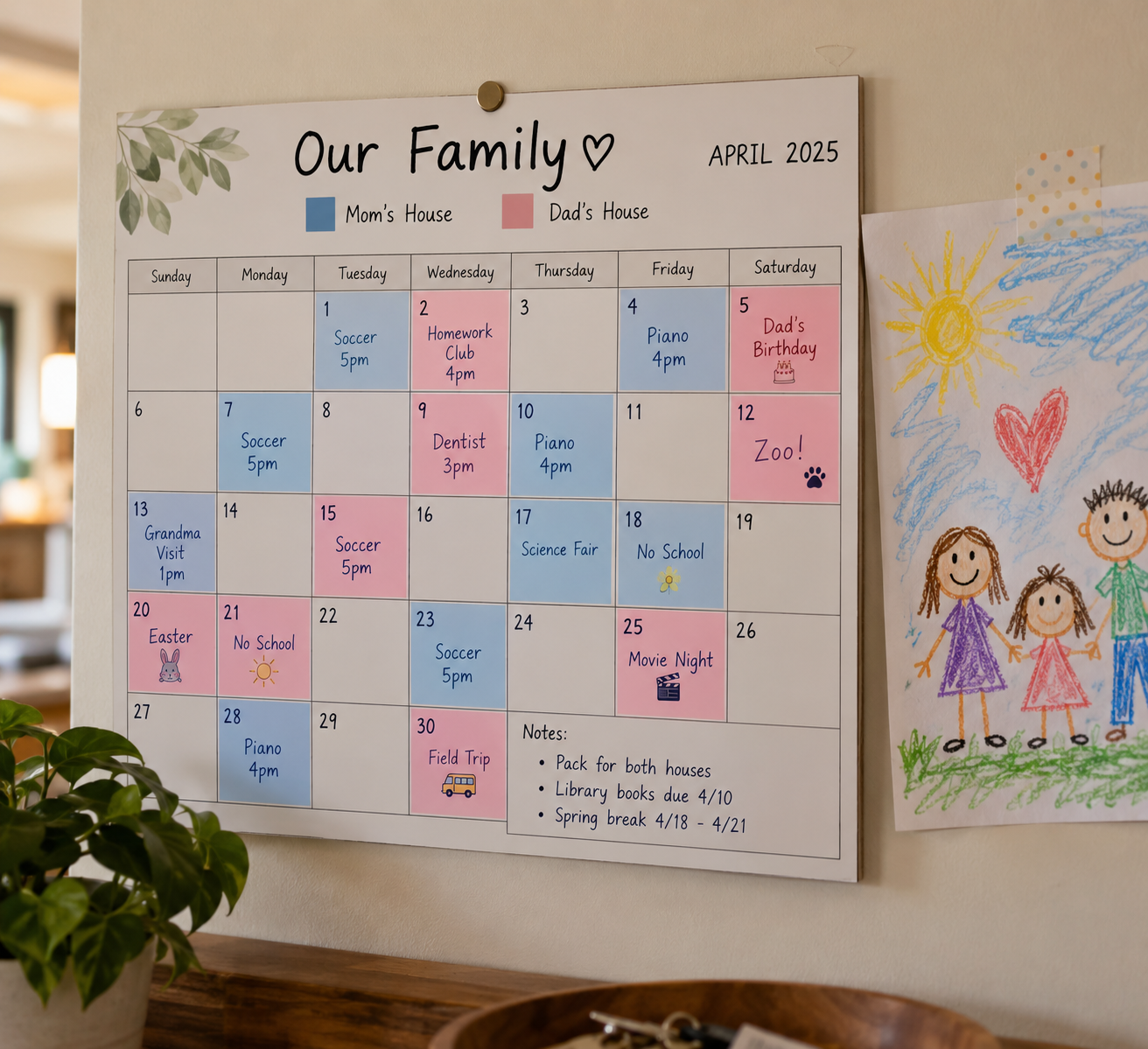
Color-coded family calendar showing a time-sharing schedule between two households under a Florida parenting plan.
By Sayra Besner, LCSW
Your lawyer emailed over a draft Florida parenting plan with the subject line "Please review and let me know your thoughts." That was Thursday.
You've opened it six times. You've read the first page six times. You got to the section about "shared parental responsibility" and something about "the parties shall confer" and your eyes slid right off the screen like it was written in a language you used to know.
Meanwhile, you're supposed to have "thoughts." About which Thanksgivings your kids spend with you for the rest of their childhood. About where they'll be on Tuesdays. About who decides if they get braces. In a form with checkboxes.
Here's the thing nobody says out loud: the parenting plan isn't hard to read because you're not smart enough. It's hard to read because it's a legal document about the most emotional thing in your life, and your brain keeps flinching.
So let's take the legal part off the table for a minute, and translate it into parent.
Before we go further: I'm a licensed therapist, not a lawyer. This is general information to help you understand what you're reading, not legal advice. Every case is different, laws change, and your family law attorney is the person to ask about yours.
What Is a Florida Parenting Plan, in Plain English?
It's the instruction manual for how your kids' lives work across two homes. Florida requires one in every divorce or paternity case involving minor children (Florida Statute 61.13).
Two big ideas run through every plan, and almost every fight about a plan is really about one of these:
Parental responsibility is about decisions. Who gets a say in the big stuff: school, non-emergency health care, religious upbringing. Florida's default is shared parental responsibility, which means both parents make those major decisions together, unless a court finds that would be harmful to the child.
Time-sharing is about the schedule. Where your kids sleep, on which nights, which holidays, and how summer breaks down.
You'll notice Florida doesn't really use the words "custody" or "visitation" in this context anymore. The state shifted to this language years ago, partly to move away from the idea that one parent "wins" the kids and the other visits them.
The 2023 Change Every Florida Parent Should Know About
In 2023, Florida passed a law (HB 1301) that created a rebuttable presumption that equal time-sharing is in a child's best interests. It took effect July 1, 2023 (Florida Senate, 2023).
In parent language: if your case goes in front of a judge, the starting assumption is now 50/50. A parent who wants something different has to show, by a preponderance of the evidence, that equal time-sharing wouldn't be best for the child.
That doesn't mean 50/50 is automatic, and it doesn't mean you and your co-parent can't agree to something else. Parents can agree to whatever schedule works for their family, and a court can approve it. The presumption mostly matters when you can't agree.
When a judge does have to decide, they look at a long list of best-interest factors, roughly twenty of them, covering things like each parent's ability to put the child's needs first, to encourage a relationship with the other parent, to keep a stable routine, and any history of domestic violence or abuse (Florida Statute 61.13(3)).
The same law also changed how plans get modified later. A parent asking to change the plan no longer has to show that the change in circumstances was "unanticipated," only that it's substantial and material and that the change is in the child's best interests. Translation: it's a bit easier to revisit the plan as life changes.
What Actually Has to Be in the Plan?
At a minimum, Florida law says a parenting plan has to cover:
How the parents will share the daily tasks of raising the child
The time-sharing schedule
Who's responsible for health care, school-related matters (including which address is used for school boundaries and registration), and other activities
The methods and technologies the parents will use to communicate with the child
That's the minimum. Good plans go much further: holidays, school breaks, transportation, who covers what extracurricular costs, how the plan handles a child's birthday, and what happens when one parent wants to swap a weekend.
Florida also has different plan forms for different situations, including a standard plan, a safety-focused plan for cases with serious safety concerns, and a long-distance plan for parents who live far apart. Your attorney will know which one fits.
What Time-Sharing Schedules Actually Look Like
When people hear "50/50," they picture one thing. In real life, it comes in several shapes:
Week on, week off. Simple, fewer handoffs. Works well for older kids. Can feel long for little ones who miss the other parent after a few days.
2-2-3. Two days with one parent, two with the other, then a three-day weekend, alternating each week. Lots of contact with both parents, which is good for younger kids, but also lots of handoffs.
2-2-5-5. Each parent has the same two weekdays every week, and weekends alternate. Predictable for school schedules, and kids always know Monday is Mom's.
There's no magic schedule. The best one is the one that matches your kids' ages, your actual work schedules, how far apart you live, and how many handoffs the two of you can manage without a fight.
Why the Usual Advice Doesn't Work
"Just sign the standard form." The standard form is a starting point, not a plan. Vague plans create conflict, because every gap becomes something to negotiate later. If the plan doesn't say who has the kids on Halloween, you're going to find out how your ex feels about Halloween.
"Let the lawyers handle it." Lawyers handle the legal side. They can't tell you whether your seven-year-old will do better with fewer transitions, or whether you'll actually make it from your office to pickup by 5:30. You know your kids. Your input is the most important part of this document.
"50/50 is always the fairest." Equal and fair aren't always the same thing. Sometimes 50/50 is exactly right. Sometimes the fairest plan for your kids looks different because of ages, school, work, or distance. The research on children after divorce is consistent that what matters most is stability and low conflict, not a perfect split of the calendar (Kelly & Emery, 2003).
What the Form Never Asks You
The parenting plan covers schedules and decisions. It doesn't ask the questions that actually decide how this goes:
How will you handle it when your kid cries at handoff? What will you say when she asks why she can't bring the dog to Dad's? How will you talk about your co-parent in front of the kids? How will you handle the first Christmas morning without them?
That's where the work actually is, and it follows the same sequence I use with everything: where you are (you can't negotiate well from panic), what you inherited (how your own parents handled two households, or didn't), what you choose (the priorities you'll actually fight for, and the ones you'll let go), boundaries (how you'll communicate so the plan doesn't become a battlefield), and what's next (the version of your family that lives inside the schedule).
A Couple More Florida Basics
If you have children under 18, both parents must complete a four-hour Parent Education and Family Stabilization Course before the court will enter a final judgment (Florida Statute 61.21). Take it early. It's more useful before your plan is finalized than after.
If either parent wants to move 50 miles or more away for 60 days or longer after a plan is in place, Florida's relocation law kicks in, requiring either written agreement from the other parent or court approval (Florida Statute 61.13001). Worth knowing before you sign a lease across the state.
What This Means for You
You don't have to love the parenting plan. You don't have to understand every legal term. You do get to have opinions about your own kids' lives, and those opinions matter more than you might think.
This document is about your children's childhood. You're allowed to slow down and get it right.
Where to Start
Start with a free 15-minute consult. I work with parents on the part the form doesn't cover: getting clear on what you want, communicating with your co-parent without blowing it up, and helping your kids through the transition. Therapy for life during and after divorce is designed for exactly this stage.
If you're dealing with an ex who turns every detail into a fight, read Co-Parenting With a High-Conflict Ex in Florida. And if you want to start on your own first, the Sayra C Method walks through the boundaries piece step by step.
Book your free consult and walk into your next draft with actual thoughts.
FAQ
Does Florida still use the word custody? Not in the traditional sense. Florida law uses "parental responsibility" for decision-making and "time-sharing" for the schedule. Most Florida cases default to shared parental responsibility, meaning both parents make major decisions together. Many people still say "custody" casually, but your paperwork and your attorney will use the newer terms.
Is 50/50 time-sharing automatic in Florida? No, but it's the starting point if a judge decides. Since July 1, 2023, Florida law presumes equal time-sharing is in a child's best interests, and a parent who disagrees must prove otherwise by a preponderance of the evidence. Parents can still agree to a different schedule. Ask your family law attorney how this applies to your case.
What has to be in a Florida parenting plan? At minimum, how parents share daily tasks, the time-sharing schedule, who handles health care and school matters (including the address used for school), and how parents will communicate with the child, including the technology they'll use. Most good plans also cover holidays, school breaks, transportation, and extracurricular costs in detail.
Can I move away with my child after a divorce in Florida? If you want to relocate 50 miles or more from your current residence for at least 60 consecutive days, Florida law requires either a written agreement with the other parent or court approval. Moving without following the process can have serious legal consequences. Talk to a family law attorney before making plans.
Can a Florida parenting plan be changed later? Yes. A parent can ask the court to modify the plan by showing a substantial and material change in circumstances and that the change is in the child's best interests. Since 2023, the change no longer has to have been unanticipated. Parents can also agree to modifications and submit them for court approval.
Do we have to take a parenting class to get divorced in Florida? Yes, if you have minor children. Both parents must complete a four-hour Parent Education and Family Stabilization Course from a provider approved by the Florida Department of Children and Families before the court will finalize the divorce. Many approved courses are available online.
References
Florida Senate. (2023). CS/HB 1301 — Parenting and time-sharing of minor children [Bill summary]. https://www.flsenate.gov/Committees/BillSummaries/2023/html/1301
Florida Statutes § 61.13, Support of children; parenting and time-sharing; powers of court.
Florida Statutes § 61.13001, Parental relocation with a child.
Florida Statutes § 61.21, Parenting course authorized; fees; required attendance authorized; contempt.
Kelly, J. B., & Emery, R. E. (2003). Children's adjustment following divorce: Risk and resilience perspectives. Family Relations, 52(4), 352–362.

About the author
I'm Sayra Besner, LCSW. Licensed clinical social worker, divorced mom of two, and the person who walked out of a beautiful house with two trash bags and no plan. I work with women, men, and teenagers 14 and up across Florida, virtually. I'm direct, I use humor, and I won't tell you everything happens for a reason.
